




According to IMARC Group’s report titled “India Water Heater Market Size, Share, Trends and Forecast by Product Type, Application and Region, 2026-2034“, the report offers a comprehensive analysis of the industry, including market share, forecast, growth and regional insights.
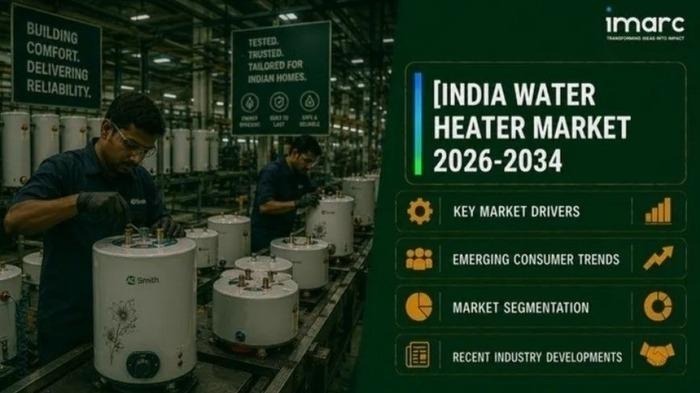
How Big is the India Water Heater Market?
The India water heater industry size reached USD 1.2 Billion in 2025. Looking forward, IMARC Group expects the market to reach USD 2.2 Billion by 2034, exhibiting a growth rate (CAGR) of 6.30% during 2026-2034. The market is experiencing sustained expansion propelled by rapid urbanization, rising disposable incomes, and an escalating demand for energy-efficient utility solutions across residential and commercial sectors. The industry is structurally pivoting toward intelligent IoT-enabled models and highly efficient heat pump technologies to maximize operational efficiency and substantially reduce long-term electricity consumption.
What are the Key Developments and Emerging Shifts in the India Water Heater Market?
Integration of IoT and Smart Technologies
Consumers are increasingly shifting toward smart water heaters integrated with Internet of Things (IoT) capabilities. These advanced appliances allow users to remotely control heating schedules, monitor time-of-day power consumption, and optimize peak-load management via mobile applications, ensuring superior energy efficiency for modern tech-savvy households.
Adoption of Renewable and Heat Pump Solutions
The sector is undergoing a fundamental technological restructuring driven by sustainability goals. Manufacturers are aggressively expanding their portfolios with DC-powered solar water heaters and advanced heat pumps. These innovations drastically reduce reliance on conventional electricity, offering highly cost-effective, long-term thermal solutions for both residential and commercial deployments.
What Factors are Driving Growth in the India Water Heater Market?
Government Incentives for Energy Efficiency
Stringent energy efficiency mandates by the Bureau of Energy Efficiency (BEE) and aggressive subsidies under the Ministry of New and Renewable Energy (MNRE) are powerful growth catalysts. These frameworks incentivize the mass adoption of solar water heating systems (SWHS), effectively pushing consumers to upgrade from substandard, non-compliant appliances to certified energy-efficient alternatives.
Rapid Urbanization and Real Estate Expansion
The massive boom in high-rise residential projects and urban infrastructure development creates continuous operational demand. As urbanization limits spatial availability, compact, space-saving instant water heaters have become an absolute necessity in heavily congested cities, fundamentally driving high-volume sales across metropolitan corridors.
How will the India Water Heater Market Evolve in the Coming Years?
The India water heater market is positioned for stable, volume-driven expansion through 2034, structurally supported by the nation's massive affordable housing push and rural electrification. As the digital grid infrastructure matures, the transition toward fully automated, AI-driven thermal management and grid-interactive water heaters will dictate long-term capacity requirements. Stakeholders who strategically invest in highly localized manufacturing of solar panels, advanced IoT sensors, and robust omnichannel distribution networks will remain uniquely positioned to capture dominant market share across both residential and commercial verticals over the forecast period.
➤ Request Sample Report (TOC & Charts): https://www.imarcgroup.com/india-water-heater-market/requestsample
Deep-Dive Segment Insights:
Product Type Insights:
- Electric Water Heater
- Solar Water Heater
- Gas Water Heater
- Heat Pump Water Heater
Application Insights:
- Residential
- Commercial/Industrial
Regional Insights:
- North India
- South India
- East India
- West India
Recent Market Developments
- BEE recently updated its strict star-rating energy efficiency thresholds for both instantaneous and storage water heating appliances.
- MNRE massively scaled capital subsidies for institutional solar water heating grid integrations across state-level commercial infrastructure.
- BIS aggressively enforced mandatory quality control orders, strictly prohibiting uncertified, non-compliant regional water heaters.
- DPIIT strongly intensified targeted manufacturing incentives to localize critical internal heating component fabrication nationwide.
By the IMARC Group, the Top Competitive Landscape & their Positioning:
Covering an in-depth analysis of the competitive landscape, market structure, key player positioning, competitive dashboards, top winning strategies, and detailed profiles of all major industry participants you will gain access to all these exclusive insights within the full research report.
Note: If you need specific information that is not currently within the scope of the report, we can provide it to you as a part of the customization.
➤ Shape the Data to Answer Your Specific Questions - Request Customization: https://www.imarcgroup.com/request?type=report&id=29310&flag=E
Frequently Asked Questions (FAQs)
1. How big is the India water heater market?
According to IMARC Group, the India water heater market size reached USD 1.2 Billion in 2025.
2. What is the expected market growth by 2034?
IMARC Group expects the market to reach USD 2.2 Billion by 2034, exhibiting a CAGR of 6.30%.
3. What are the key factors driving the market?
IMARC Group identifies rapid urbanization, rising disposable incomes, and government energy-efficiency incentives as primary growth drivers.
4. Which technological shift is currently shaping the market?
According to IMARC Group, consumers are heavily migrating toward advanced heat pump and IoT-enabled smart water heaters.
5. How is the solar water heater segment performing?
IMARC Group notes that government subsidies and declining solar panel prices are aggressively expanding the solar water heating segment.
Strategic Insight & Verdict
The Indian water heater market is undergoing a fundamental technological restructuring driven directly by aggressive state-mandated energy efficiency frameworks. As BEE and MNRE enforce stringent regulatory standards, structural reliance on high-consumption legacy appliances is rapidly vanishing. For high-level B2B stakeholders, state-backed green infrastructure expansions present a permanently lucrative, high-intent landscape perfectly optimized for scalable, advanced, and eco-certified thermal manufacturing capital investments.


Comments (0)