





The way an invoice moves between two companies is becoming just as important as the information written on it. Traditional workflows often depend on PDFs, email attachments, manual data entry, and separate accounting systems. A structured electronic model changes that process by allowing invoice information to move between connected systems in a standard format.
For UAE businesses, understanding the UAE e-invoicing framework is becoming increasingly important as the country adopts an OpenPeppol-based approach. The change affects more than invoice delivery. Businesses also need to consider their accounting software, data quality, service provider, internal processes, and implementation timeline.
For finance and technology teams, the important question is not simply what Peppol is. It is how the model affects their existing invoice workflow and what they need to prepare before mandatory implementation.
What Peppol E-Invoicing Actually Means
Peppol is a framework for exchanging electronic business documents using common technical standards. Its purpose is to help different organisations and systems exchange structured information without requiring businesses to create separate technical connections for every trading partner.
In the UAE, the electronic invoicing framework uses OpenPeppol as part of its technical foundation. This allows accredited service providers to connect businesses to the electronic invoice exchange network.
The important point is that an eInvoice is not simply a digital copy of a paper invoice. A PDF, scanned document, image, Word file, or ordinary email invoice does not become an eInvoice simply because it is digital. The UAE framework focuses on structured invoice data that can be electronically exchanged and reported through the required channels.
How an Invoice Moves Through the Peppol-Based Model
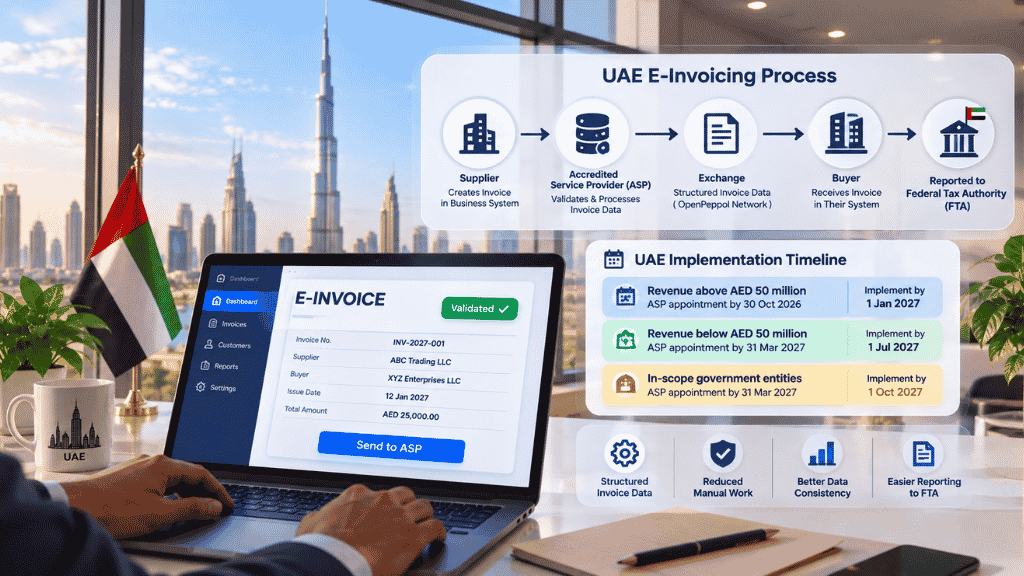
The UAE framework uses Accredited Service Providers to handle the exchange of structured invoice information. A simplified transaction begins when a supplier creates invoice data in its business software and sends it to its chosen service provider.
The sending provider validates the invoice data and transmits it to the buyer's Accredited Service Provider through the OpenPeppol network. The receiving provider then validates the information and delivers the invoice to the buyer's business software in the required format.
The framework also connects invoice exchange with reporting to the government's central data infrastructure. This means businesses need to consider both the exchange of invoice information and the associated reporting requirements when preparing their systems.
For businesses, this model reduces the need to establish individual technical connections with every customer or supplier. Accredited providers act as the connection points within the wider framework.
Where Existing Invoice Processes May Need Attention
Moving to Peppol e-invoicing does not necessarily mean replacing an entire accounting or ERP system. However, businesses should examine how their current systems create, exchange, record, and store invoice information.
One area to review is master data. Customer and supplier details, tax information, invoice numbers, product or service descriptions, and other invoice fields need to be accurate and consistently maintained. Poor-quality data can create validation problems even when the underlying software supports electronic invoicing.
Businesses should also identify manual steps. If employees regularly copy invoice information from emails into accounting software or move data between separate systems, those processes may need to be redesigned.
Exception handling deserves attention as well. A practical electronic invoicing process needs a way to deal with rejected invoices, incorrect information, failed validations, and corrections without creating inconsistencies in accounting records.
What to Look for in an Accredited Service Provider
The Accredited Service Provider is a central part of the UAE's Peppol-based eInvoicing model. The Ministry of Finance maintains an official list of accredited providers, which businesses can use when assessing their options.
The right choice will depend on the organisation's existing systems and transaction requirements. Instead of looking only at general software capabilities, finance and IT teams can ask practical questions about implementation.
- Can the provider connect with the company's existing ERP or accounting software?
- How will outgoing and incoming invoice data move between systems?
- How are validation errors and rejected invoices handled?
- What testing is available before production use?
- What support is available during onboarding and after implementation?
- Can the service accommodate the organisation's expected invoice volume?
Businesses should also verify that the provider appears on the current official accreditation list.
Why the UAE Implementation Timeline Matters
The UAE's eInvoicing rollout is phased rather than based on one common deadline for every organisation. Voluntary implementation began on 1 July 2026, while mandatory implementation depends on the organisation's circumstances.
For businesses with annual revenue of AED 50 million or more, the implementation date is 1 January 2027. The deadline for appointing an Accredited Service Provider for this group is 30 October 2026.
Businesses with annual revenue below AED 50 million must appoint an Accredited Service Provider by 31 March 2027 and implement eInvoicing by 1 July 2027. Government entities covered by the framework have the same ASP appointment deadline, with implementation required by 1 October 2027.
These dates make preparation important because connecting systems, reviewing data, testing invoice flows, and training employees can take time. The implementation deadline should therefore be treated as the point by which the organisation is ready, rather than the point at which preparation begins.
A Practical Readiness Check for Finance and IT Teams
A useful starting point is to map the complete invoice journey. Teams can document where an invoice originates, which system creates it, how it is approved, where it is sent, how the recipient records it, and how tax information is reported.
The review should then identify gaps between the current process and the structured electronic model. Data quality, system connectivity, invoice fields, user responsibilities, approval workflows, and exception handling are all worth checking.
Teams can also use resources explaining the UAE e-invoicing requirements when building an internal understanding of the regulatory framework before discussing implementation with an accounting software provider or Accredited Service Provider.
The objective is to identify gaps before implementation rather than discovering them after invoices begin moving through the new workflow.
What Peppol Could Mean for Day-to-Day Invoicing
For businesses, the move to Peppol-based eInvoicing shifts attention from invoices as documents toward invoices as structured transaction data. That change can influence how finance teams create invoices, how accounting systems receive information, and how errors are identified and corrected.
The standardised network can support interoperability between different businesses and systems, but it does not remove the need for accurate data or well-designed internal processes. A company with inconsistent customer records or unclear invoice approval procedures can still face operational problems after connecting to an electronic network.
Final Takeaway
Peppol provides the technical foundation for structured electronic invoice exchange within the UAE's eInvoicing framework. For businesses, the transition is therefore not just about sending invoices electronically. It involves understanding the new exchange model and making sure existing systems and processes can support it.
A sensible preparation process starts with the applicable deadline, followed by a review of invoice workflows, data quality, system integration, and Accredited Service Provider options. Addressing these areas early can give businesses more time to test the process and resolve issues before mandatory implementation arrives.


Comments (0)