




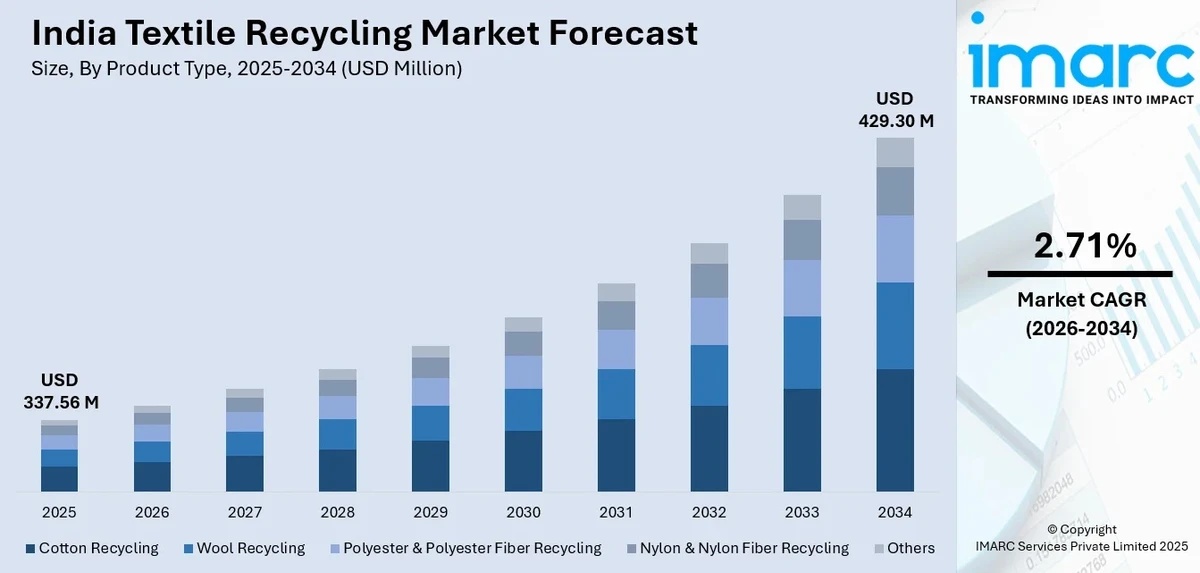
According to IMARC Group’s report titled “India Textile Recycling Market Size, Share, Trends and Forecast by Product Type, Textile Waste, Distribution Channel, End Use, and Region, 2026-2034“, The report offers a comprehensive analysis of the industry, including India textile recycling market forecast, growth and regional insights.
The India textile recycling industry size was valued at USD 337.56 Million in 2025 and is projected to reach USD 429.30 Million by 2034, growing at a compound annual growth rate of 2.71% from 2026-2034.
India’s retail and textile manufacturing sector is executing a critical structural pivot from linear production models to a formalized circular economy, driven by global sustainability mandates and the urgent need for resource optimization.
- Pre-consumer textile waste dominates the feedstock distribution, capturing a 55% market share in 2025 due to homogenous scraps sourced directly from industrial garment factories.
- The apparel sector represents the primary end-use application, holding a 52% segment share as sustainable fashion brands aggressively integrate recycled cotton (which leads product types at 32%) into new collections.
- Geographically, North India commands the market with a 30% share, anchored by established recycling clusters in Panipat and Ludhiana.
The Strategic Market Challenge: Navigating the Textile Recycling Market in India
A critical structural bottleneck within the retail and apparel sector is the severe fragmentation of post-consumer collection networks and the high cost of manual sorting. Leaders frequently overlook the complex multi-fiber composition of modern garments, where elastane and polyester blends severely complicate mechanical shredding and chemical depolymerization. This feedstock inconsistency inflates operational overheads, compresses processing margins, and forces organized recyclers to rely heavily on pre-consumer industrial waste, delaying the scalable recovery of post-consumer textiles required to meet stringent corporate circularity targets.
➤ Access Key Market Statistics and Actionable Insights - Request Sample Report: https://www.imarcgroup.com/india-textile-recycling-market/requestsample
India's Strategic Vision for the Textile Recycling Market
- Mega Textile Parks and Circularity: Supported by the PM MITRA scheme, the macro-level vision involves integrating shared scientific waste management facilities, Common Effluent Treatment Plants (CETPs), and recycling systems within unified, large-scale industrial clusters.
- Formalization of Waste Management: The national goal is to shift textile waste recovery from the unorganized sector into a formalized value chain, optimizing traceability and ensuring high-quality feedstock for both fiber-to-fiber recycling and Refuse-Derived Fuel (RDF).
- Carbon Emission Reduction: By incorporating textile units under the Carbon Credit Trading Scheme (CCTS), the strategic vision legally incentivizes manufacturers to adopt energy-efficient recycling technologies to meet strict Greenhouse Gas Emission Intensity (GGI) targets.
Why Invest in the India Textile Recycling Market: Key Growth Drivers & ROI
- Sustainable Fashion Premiumization: Retail and departmental stores, which control 73% of the distribution channel, are capitalizing on shifting consumer demographics. Investors capturing this D2C demand achieve high ROI by supplying premium, eco-labeled recycled apparel to a rapidly expanding, environmentally conscious middle class.
- Supply Chain Cost Arbitrage: Integrating recycled cotton and polyester insulates manufacturers from the extreme price volatility of virgin agricultural cotton and petrochemical derivatives. This localized feedstock sourcing structurally stabilizes raw material procurement costs and protects long-term manufacturing margins.
- Cluster-Based Operational Efficiency: Allocating capital toward established hubs like Panipat, Ludhiana, Tirupur, and Surat allows investors to plug directly into pre-existing, hyper-efficient reverse logistics networks. This proximity to raw industrial waste drastically minimizes transportation friction and ensures continuous high-volume processing capabilities.
India Textile Recycling Market Trends & Future Outlook
- AI-Driven Automated Sorting: The market is rapidly adopting hyperspectral imaging and AI-enabled robotics to instantly identify and sort multi-blend fabrics, drastically reducing manual sorting errors and processing time.
- Chemical Recycling Commercialization: Long-term trajectories point toward massive capital deployment in chemical dissolution technologies capable of separating polyester-cotton blends at the molecular level, yielding virgin-equivalent outputs.
- Brand-Led Take-Back Programs: Major fashion retailers are institutionalizing reverse logistics by installing in-store collection bins, structurally formalizing the post-consumer supply chain and boosting foot traffic.
- Digital Product Passports (DPP): To comply with export requirements (especially for European markets), the sector is aggressively integrating blockchain traceability to verify the exact percentage of recycled content throughout the apparel lifecycle.
Regulatory Landscape & Policy Catalysts in India
- Solid Waste Management Rules 2026: According to the Ministry of Environment, Forest and Climate Change (MoEFCC), the updated SWM Rules effective April 2026 mandate a progressive increase in fuel substitution for cement plants, categorizing non-recyclable textile waste as essential feedstock for Refuse-Derived Fuel (RDF).
- PM MITRA Scheme: As administered by the Ministry of Textiles, the government has allocated ₹4,445 crore to develop seven mega integrated textile regions, explicitly mandating the inclusion of shared, scientific textile recycling infrastructure.
- Carbon Credit Trading Scheme (CCTS): According to the Ministry of Power and the Bureau of Energy Efficiency, designated textile units are now obligated to meet specific emission intensity targets, incentivizing the adoption of low-carbon recycled materials.
- Public Procurement of Upcycled Goods: The Government e-Marketplace (GeM) has integrated specialized portals to facilitate the direct public procurement of upcycled and recycled textile products, providing a guaranteed institutional market for MSMEs.
- FDI in Textile Manufacturing: According to Invest India, 100% Foreign Direct Investment is permitted under the automatic route for the textile sector, actively encouraging global institutional capital to fund advanced sorting and chemical recycling facilities.
➤ Explore the Exact Chapters and Data Scope - Get Full Brochure: https://www.imarcgroup.com/request?type=report&id=4042&flag=A
India Textile Recycling Market Segmentation:
The market report offers a comprehensive analysis of the segments, highlighting those with the largest India textile recycling market share. It includes forecasts for the period 2026-2034 and historical data from 2020-2025 for the following segments.
Product Type Insights:
- Cotton Recycling
- Wool Recycling
- Polyester & Polyester Fiber Recycling
- Nylon & Nylon Fiber Recycling
- Others
The cotton recycling dominates with a market share of 32% of the total market in 2025.
Textile Waste Insights:
- Pre-consumer Textile
- Post-consumer Textile
The pre-consumer textile leads with a share of 55% of the total market in 2025.
Distribution Channel Insights:
- Online Channel
- Retail & Departmental Stores
The retail & departmental stores dominate with a market share of 73% of the total market in 2025.
End Use Insights:
- Apparel
- Industrial
- Home Furnishings
- Non-woven
- Others
The apparel leads with a share of 52% of the total market in 2025.
Region Insights:
- North India
- West and Central India
- South India
- East India
North India exhibits a clear dominance with a 30% share of the total market in 2025.
By the IMARC Group, the Top Competitive Landscape & their Positioning:
Covering an in-depth analysis of the competitive landscape, market structure, key player positioning, competitive dashboards, top winning strategies, and detailed profiles of all major industry participants you will gain access to all these exclusive insights within the full research report.
Note: If you need specific information that is not currently within the scope of the report, we can provide it to you as a part of the customization.
➤ Shape the Data to Answer Your Specific Questions - Request Customization: https://www.imarcgroup.com/request?type=report&id=4042&flag=E
Frequently Asked Questions (FAQs)
1. What is the current value and projected growth of the India Textile Recycling Market?
According to IMARC Group, the market was valued at USD 337.56 Million in 2025 and is projected to reach USD 429.30 Million by 2034, growing at a CAGR of 2.71% (2026–2034).
2. What is driving the growth of the market?
Growth is driven by rising environmental concerns, increasing demand for sustainable fashion, and government regulations promoting recycling and circular economy practices.
3. Why is textile recycling gaining importance in India?
It helps in reducing textile waste, conserving resources, and supporting sustainable manufacturing practices across the fashion and textile industry.
4. What are the key trends in the India textile recycling market?
Key trends include growing adoption of recycled fibers, advancements in recycling technologies, and rising awareness of ethical sourcing and eco-friendly products .
5. Which materials are commonly recycled in this market?
Commonly recycled materials include cotton, polyester, wool, and blended fabrics, used across apparel and industrial applications.
Strategic Insight & Verdict
Having analyzed the trajectory of India’s textile recycling market, we observe a decisive shift toward circular value chains driven by sustainability mandates and global sourcing requirements. Demand is increasingly centered on traceability, fiber recovery efficiency, and high-quality recycled outputs. Companies that invest in advanced sorting technologies, scalable recycling infrastructure, and compliance frameworks will secure long-term advantage as ESG-driven procurement becomes a defining industry standard.
Gaurav, Digital Market Research Strategist at IMARC Group: https://www.linkedin.com/in/gourav-shah-005425345
Verified Data Source: IMARC Group
Contact Us:
IMARC Group
134 N 4th St. Brooklyn, NY 11249, USA
Email: sales@imarcgroup.com
Tel NoD) +91 120 433 0800
United States: +1-202071-6302


Comments (0)